
Entertainment
Kevin Costner and Christine Baumgartner’s Divorce: Everything to Know on September 19, 2023 at 7:07 pm Us Weekly


Kevin Costner’s divorce from estranged wife Christine Baumgartner got off to a messy start — and lasted four months before they finalized their legal battle in September 2023..
Us Weekly confirmed in May 2023 that Baumgartner had filed for divorce from the Oscar winner after 19 years of marriage, citing irreconcilable differences.
Costner met Baumgartner on a golf course in the ‘90s while he was preparing to play a professional golfer in the 1996 film Tin Cup. Following his 1994 split from ex-wife Cindy Silva — with whom he shares kids Annie, Lily and Joe — Costner began dating Baumgartner in 1999. The pair tied the knot in September 2004 and went on to welcome sons Cayden and Hayes and daughter Grace. (Costner also shares son Liam with ex Bridget Rooney.)
Following Baumgartner’s divorce filing, a source exclusively told Us that Costner was “deeply saddened” by their breakup but was working to try to “save his marriage.” The insider added: “Kevin loves his wife and children so this has been very hard on him. He is saying that this is his worst nightmare and he would do anything for his family.”
Baumgartner, meanwhile, was experiencing her own roller-coaster of emotions. “Christine feels he should be the one to go,” another source told Us in June 2023, referring to Baumgartner’s decision to remain in her and Costner’s shared home despite their prenup stating she has 30 days to vacate the property. “She’s so angry with Kevin for what she feels led to the end of their marriage — him putting work ahead of the family.”
Scroll below for all the details on Costner and Baumgartner’s ongoing divorce:
Christine Files for Divorce
Although Baumgartner filed for divorce in May 2023, court documents obtained by Us reveal that the pair actually split one month prior. Costner, for his part, filed a response in May 2023, which mentioned that he and Baumgartner signed a prenuptial agreement before their wedding.
Amid news of their separation, the handbag designer was spotted without her wedding ring in Los Angeles in photos obtained by the Daily Mail.
Gregory Pace/Shutterstock
The Fight Over Yellowstone
“Christine wasn’t happy with Yellowstone‘s schedule delays because it caused him to miss so much time with his family,” an insider told Us in May 2023, claiming that the Paramount+ series — which premiered in 2018 — was “one of the reasons” for the duo’s split.
The source continued: “[Costner] was on the fence about doing the show from the beginning. He had to be convinced to do the project. There were months of discussions with Kevin and his family before he did it. He didn’t want do the show without their input.”
According to the insider, delays on the second half of Yellowstone‘s fifth and final season “led to a lot of problems” between the estranged spouses. “Kevin’s team even asked about the possibility of moving the show to California so he could film certain scenes,” the source noted. “It’s been a discussion through the years, but it never worked out. Kevin has been making a lot of effort to make it work for his family.”
Baumgartner reportedly argued in June 2023 court docs that she “did not pressure Kevin to leave the Yellowstone show.”
In August 2023, Baumgartner’s legal team claimed that Costner “refused to answer questions about whether he was offered the opportunity to star in Season 6, or if he simply chose to quit.” Regardless, the attorneys argued that Costner would still be “entitled to a percentage of profit participation” from the show even after his exit. (Costner previously claimed he couldn’t afford Baumgartner’s child support requests because his income would diminish following his exit from the series.)
David Fisher/Shutterstock
Money Woes
In court documents obtained by Us in June 2023, Costner claimed that his estranged wife withdrew “from my bank account and charged on my credit card a total of $95,000, payable to her divorce attorneys and forensic accountant.” He alleged that she had been doing so since April 2023 without his knowledge or consent.
Costner subsequently explained in a filing obtained by Us in July 2023 that he had “no choice” but to reduce his ex’s credit card limit to $30,000 per month due to her “charging large sums” without his knowledge. He referred to the decision as a “reasonable limitation.”
The Fight for Their Home
Costner alleged in June 2023 legal paperwork that Baumgartner was refusing to move out of their shared home, despite their prenup stating she had 30 days to vacate the property following their split. According to Costner, Baumgartner was using the situation to make him comply with “various financial demands.” He acknowledged that he could “contribute as part of his child support obligations $30K per month for a rental house and is willing to advance another $10K for her moving costs.”
Baumgartner’s lawyer, John Rydell, later stated in court documents obtained by Insider that Costner has no “legal” right to force her to leave. “Although the legal basis for Kevin’s request to kick his wife and children out of their home is all but nonexistent, this is still a matter of critical importance for Christine,” the lawyer explained in June 2023.
Baumgartner further claimed in June 2023 court documents obtained by Us that she has “no personal income” which makes it impossible to vacate their joint home. “Christine understands that at some point in the future she and the children will have to move out of the family home,” the filing read. “She cannot do so at this early stage of the case because she does not have sufficient funding to secure housing that will ensure the children can maintain similar standards of living in the parties’ respective homes.”
Us confirmed via court docs in July 2023 that a judge denied Baumgartner’s request to remain on the property until August 2023.
Baumgartner apparently moved out of the couple’s home in late July 2023, a few days before the court-ordered deadline. Prior to her departure, the exes feuded over the division of household items — literally down to kitchen utensils. In court docs filed in July 2023, Baumgartner claimed that Costner was worried she was going to “take too many pots and pans.”
Child Support
Baumgartner reportedly asked for $248,000 a month in child support, stating in a court filing that the figure “is less than the amount needed to maintain the children in their accustomed lifestyle.”
Baumgartner also requested that Costner solely pay for their kids’ private school education, health care expenses and fees related to extracurricular activities and sports, but did not mention any requests for spousal support.
In June 2023 court documents obtained by Us, Baumgartner claimed that Costner makes an estimated $1,537,000 a month from his various jobs as an actor and director. She noted that while Costner has “continued to pay all of” their expenses since their separation, Costner has not made it easy for Baumgartner to pay for things.
“Thus far, Kevin has not been willing to commit to paying an appropriate amount of child support,” she alleged. “I have been willing to move out of the family home, but I cannot do so without support from Kevin.”
Costner, for his part, denied he was “kicking” his children out of their home in court docs obtained by Us in June 2023. “I am only requesting that Christine vacate my separate property home and find alternate living arrangements,” he alleged.
In documents filed later that month and obtained by Us, the actor noted that because he is “no longer under contract for Yellowstone,” he “will earn substantially less in 2023 than I did in 2022″ — and cannot pay the $248,000 per month his estranged wife is requesting in child support.
One month later, Fox News reported that Baumgartner will receive $129,755 per month from Costner in child support, in addition to the actor paying $200,000 and $100,000 in attorneys’ fees and forensic costs, respectively. The duo pay equal expenses for their children’s health care, activities and sports on the “first of each month,” according to the outlet, with “credit sums paid between July 1 and July 12.”
Ahead of an August 2023 child support hearing, Baumgartner requested $175,057 a month from Costner, claiming that amount would help the kids maintain a “lifestyle relatively comparable” to the one they enjoy when they’re with their father.
“Because the children fly on private aircraft to go on luxury vacations when they are with their father, the Family Code dictates that Kevin should pay sufficient child support to Christine so that the children can go on comparable vacations when they are with her. This is true even if the child support payments also improve Christine’s lifestyle,” Baumgartner’s lawyers claimed in a brief filed ahead of the hearing. “Kevin will argue that Christine doesn’t need to provide the children with many of the things to which they have become accustomed, as they can enjoy those things with Kevin. But Kevin’s argument misses the point. The children should be able to participate in their activities with each of their parents.”
Jim Ruymen/UPI/Shutterstock
A Financial Breakdown
In a June 2023 filing, Baumgartner outlined her family’s finances and household expenses. She revealed that Costner earned $19,517,064 in 2022 and the family’s expenses — without taxes — came out to $6,645,285. Some of those fees included $84,040 for household help, $78,780 for children Hayes and Grace’s education, $830,000 on gifts and $238,000 on medical costs.
Baumgartner claimed that Costner recently deposited $1 million into an account set up in her name “without my knowledge or consent.” She alleged that the deposit was a way for her estranged spouse to “force my concession that the spousal support limitation is valid by virtue of my ‘acceptance’ of these funds. I believe that Kevin’s goal is to get me to tap into this money, so he can argue that I’ve waived my right to challenge the Premarital Agreement.”
She stated that she has chosen not to accept the payment — which now includes an additional $400,000. “I cannot access these funds without risk of jeopardizing my legal rights in this case. Except for the contested funds, I have almost no financial assets to my name and zero personal income,” the docs read.
She further insisted that Costner’s recent deposits would not cover her and their kids’ continued costs as outlined in the paperwork. Baumgartner explained that the family’s multiple homes — including their Aspen property and Santa Barbara compound — cost more than $1.5 million in 2022 to upkeep. Their Beach Club costs — which includes the Santa Barbara guest house rental, gym and yard — are an additional $449,202.
Costner, for his part, alleged in a separate filing in June 2023 that Baumgartner spends 60 percent of her child support money toward her own personal expenses, including a private trainer and $188,000 — monthly — on plastic surgery.
The Rumors About the Neighbor
Rumors surfaced in June 2023 that Baumgartner allegedly hooked up with her and Costner’s former tenant Daniel Starr — who previously resided in a home on their Santa Barbara property. While Baumgartner has yet to comment, Starr told TMZ the rumors were “absolutely not” true. He insisted that he is “just a guy who paid [his] rent.”
Starr explained that he left early — he vacated the premises in March 2023 despite having a contract through June 2023 — because he “had to move on.” When pushed further about his dynamic with the estranged couple, Starr told the outlet, “I just was a tenant. I had a tenant-landlord relationship [with them]. Nothing else.”
Zoom Call Drama
Baumgartner claimed Costner told their kids about the split via Zoom, alleging that she told her estranged spouse how “important” it was to “tell the children in person and together” but Costner allegedly “disregarded” her request.
“He insisted that he had the right to tell them that we were getting divorced ‘first’ and tell them privately ‘without me present,’” Baumgartner recalled in the filing. “After a 24-year relationship, from his hotel room in Las Vegas, Kevin told our three children that we were getting divorced over a 10-minute Zoom call without me present.” She revealed that she is “still confused by his motivation to do this via a very short Zoom session, especially since he was planning on being home five days later. He also could have easily come home from Las Vegas to have the conversation in person.”
Divorce Is Finalized
Costner and Baumgartner reportedly finalized their divorce in September 2023. According to multiple outlets, the exes reached a settlement after four months of going back and forth in court. Details about their agreement have not been released.
Earlier in the month, a judge ruled in Costner’s favor in terms of his and Baumgartner’s child support battle. Costner was temporarily ordered to pay $129,755 per month in child support before a judge knocked it down to $63,209 per month beginning September 1.
Following his court appearance, Costner broke his silence about the split, telling reporters that “of course” still has “love” for his ex-wife. He called the divorce proceedings a “horrible place to be” adding that “everybody” involved was hoping to quickly resolve the legal battle.
Kevin Costner’s divorce from estranged wife Christine Baumgartner got off to a messy start — and lasted four months before they finalized their legal battle in September 2023.. Us Weekly confirmed in May 2023 that Baumgartner had filed for divorce from the Oscar winner after 19 years of marriage, citing irreconcilable differences. Costner met Baumgartner
Us Weekly Read More


Continue Reading

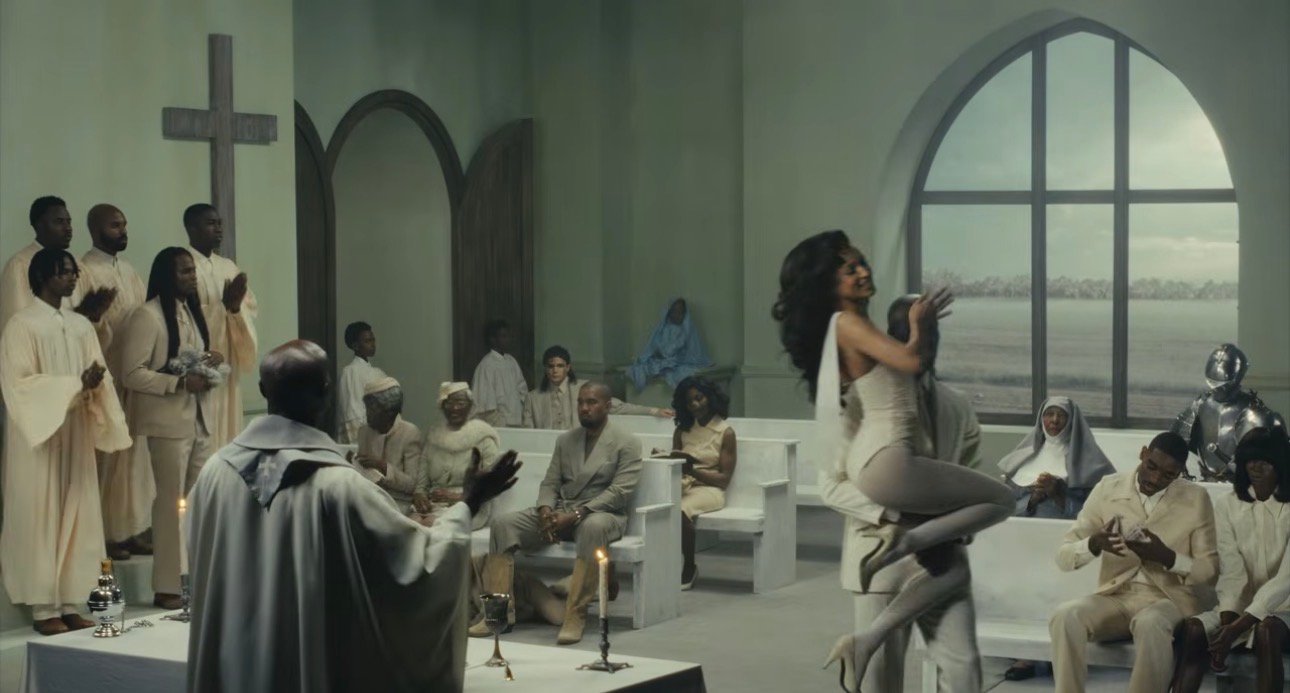
Kanye West’s “Father” video looks like a fever dream in a church, but underneath the spectacle it’s a quiet argument about who really runs the world. The altar isn’t just about God; it’s about every “father” structure that decides what’s true, who belongs, and who gets cast out.
The church as power, not comfort
The church in “Father” doesn’t behave like a safe, sacred space. It feels like a headquarters. The aisle becomes a catwalk for power: brides, a knight, a nun, a Michael Jackson double, astronauts, Travis Scott, all moving through the frame while Kanye mostly sits and watches. The room doesn’t change for them—they’re the ones being processed.
That’s the first big tell: this isn’t just about religion. It’s about systems. The church stands in for any institution that claims moral authority—governments, platforms, labels, churches, media—places where identity, status, and “truth” are negotiated behind the scenes. Faith is the language; control is the product.

Kanye as the unmanageable outsider
In this universe, Kanye isn’t the leader of the service. He’s a problem in the pews. The wildest scene makes that explicit: astronauts move in, pull off his mask, expose him as an “alien,” and carry him out. It’s funny, surreal—and brutal.
That moment plays like a metaphor for what happens when someone stops being useful to the system. If you’re too unpredictable, too loud, too off‑script, the institution finds a way to unmask you, label you, and remove you. But here’s the twist: once he’s gone, the spectacle continues. Travis still shines, the ceremony rolls on, the church keeps doing what the church does. The message is cold: no one is bigger than the machine.
Faith vs obedience
The title “Father” is doing triple duty: God, parent, and patriarchal authority. The video leans into a hard question—are we following something we believe in, or something we’re afraid to disappoint?
Inside this church, people don’t react when things get strange. A nun is handled like a criminal, cards burn, an alien is dragged away, and the room barely flinches. That’s not devotion, that’s conditioning. The deeper critique is that many of our modern “faiths”—political, religious, even fandom—have slid from relationship into obedience. You’re not invited to wrestle with meaning; you’re expected to sit down, sing along, and accept the script.
Who gets meaning, who gets sacrificed
The casting in “Father” feels like a visual ranking chart. The knight represents sanctioned force: power that’s old, armored, and legitimated by history. The cross and church setting evoke sacrifice: whose pain gets honored, whose story gets canonized, whose doesn’t. The Michael Jackson lookalike signals how even fallen icons remain useful as symbols long after their humanity is gone.
In that context, Kanye’s removal reads as a sacrifice that keeps the system intact. Take the problematic prophet out of the frame, keep the music, keep the ritual, keep the brand. The father‑system doesn’t collapse; it adjusts. Control isn’t loud in this world—it’s quiet, procedural, dressed like order.
A mirror held up to us
The most uncomfortable part of “Father” is that the congregation keeps sitting there. No one storms out. No one screams. The church absorbs aliens, icons, arrests, and weddings like it’s a normal Sunday. That’s where the video stops being about Kanye and starts being about us.
We’ve learned to scroll past absurdity and injustice with the same blank face as those extras in the pews. Faith becomes content. Outrage becomes engagement. Power becomes invisible. “Father” takes all of that and crushes it into one continuous shot, asking a bigger question than “Is Kanye back?”
It’s asking: in a world where power wears holy clothes, faith is filmed, and control looks like normal life, who is your father really—and are you sure you chose him?

The machine isn’t coming. It’s already in the room.
Picture this: you spend two years writing a script. You hustle funding, build a team, reach out to casting. Then somewhere inside a studio, a software platform analyzes your concept against fifteen years of box office data and decides—before a single human executive reads page one—that your film is too risky to greenlight.
This isn’t a Black Mirror episode. This is Hollywood in 2026.
The Numbers Don’t Lie
The generative AI market inside media and entertainment just crossed $2.24 billion and is projected to hit $21.2 billion by 2035—a 25% annual growth rate. Studios like Warner Bros. are running platforms like Cinelytic, a decision-intelligence tool that predicts box office performance with 94–96% accuracy before a single dollar of production money moves.
Netflix estimates its AI recommendation engine saves the company $1 billion per year just in subscriber retention. Meanwhile, over the past three years, more than 41,000 film and TV jobs have disappeared in Los Angeles County alone.
That’s not a trend. That’s a restructuring.

The Moment That Changed Everything
In February 2026, ByteDance’s AI generator Seedance 2.0 produced a hyper-realistic deepfake video featuring the likenesses of Tom Cruise, Brad Pitt, and Leonardo DiCaprio. It went viral instantly. SAG-AFTRA called it “blatant infringement.” The Human Artistry Campaign called it “an attack on every creator in the world.”
Then came Tilly Norwood—a fully AI-generated actress created by production company Particle 6—who was seriously considered for agency representation in Hollywood. The first synthetic human to knock on that door.
Matthew McConaughey didn’t mince words at a recent industry town hall. He looked at Timothée Chalamet and said:
“It’s already here. Own yourself. Voice, likeness, et cetera. Trademark it. Whatever you gotta do, so when it comes, no one can steal you.”
James Cameron told CBS the idea of generating actors with prompts is “horrifying.” Werner Herzog called AI films “fabrications with no soul.” Guillermo del Toro said he would “rather die” than use generative AI to make a film.
But here’s the thing—not everyone agrees.
The Indie Filmmaker’s Double-Edged Sword
At SXSW 2026, indie filmmakers made something clear in a packed panel: they don’t want AI to make their movies. They want AI to “do their dishes.”
That’s the real conversation happening at the ground level.
Independent filmmaker Brad Tangonan used Google’s AI suite to create Murmuray—a deeply personal short film he says he never could have made without the tools. Not because he lacked talent, but because he lacked budget. He wrote it. He directed it. The AI executed parts of his vision he couldn’t afford to shoot.
In Austin, an independent filmmaker built a 7-minute short in three weeks using AI-generated video—a project that would have taken 3–4 months and cost ten times more the traditional way. That’s the version of this story studios don’t want you focused on.
At CES 2026, Arcana Labs announced the first fully AI-generated short film to receive a SAG-approved contract—a milestone that proves AI-assisted production can operate inside union protections when done right.
The Fight Coming This Summer
The WGA contract expires May 1, 2026. SAG-AFTRA’s expires June 30. AI is the headline issue at the bargaining table—and the last time these two unions went to war with studios over it, Hollywood shut down for 118 days.
SAG is expected to push the “Tilly Tax”—a fee studios pay every time they use a synthetic actor—directly inspired by Tilly Norwood’s emergence. The WGA already prohibits studios from handing writers AI-generated scripts for a rewrite fee. Now they want bigger walls.
Meanwhile, the Television Academy’s 2026 Emmy rules now include explicit AI language: human creative contribution must remain the “core” of any submission. AI assistance is allowed—but the Academy reserves the right to investigate how it was used.
The Oscars and Emmys are essentially saying: the robot didn’t get nominated. The human did.
What This Means for You
If you’re an indie filmmaker between 25 and 45, you’re operating in the most disruptive creative environment since the camera went digital. AI can cut your post-production time by up to 40%. It can help you pre-visualize shots, generate temp scores, clean up audio, and pitch your project with a sizzle reel you couldn’t afford six months ago.
But the machine that helps you make your film is the same machine that could make studios decide they don’t need you to make theirs.
Producer and director Taylor Nixon-Smith said it best: “Entertainment, once a sacred space, now feels like it’s in a state of purgatory.”
The question isn’t whether AI belongs in your workflow. It’s whether you’re the one holding the wheel—or whether the wheel is slowly being handed to an algorithm that has never once felt what it means to have a story only you can tell.

As Sinners surges into the cultural conversation, it’s impossible to ignore the force of Christian Robinson’s performance. His “let me in” door scene has become one of the film’s defining moments—raw, desperate, and unforgettable. But the power of that scene makes the most sense when you understand the journey that brought him there.
From church play to breakout roles
Christian’s path didn’t begin on a Hollywood set. It started in a Brooklyn church, when a woman named Miss Val kept asking him to be in a play.
“I told her no countless times,” he remembers. “Every time she saw me, she asked me and she wouldn’t stop asking me.”
He finally said yes—and everything changed.
“I did it once and I fell in love,” he says. That one performance pushed him into deep research on the craft, a move to Atlanta, and years of unglamorous work: training, auditioning, stacking small wins until he booked his first roles and then Netflix’s Burning Sands, where many met him as Big Country.

By the time Sinners came along, he wasn’t a newcomer hoping to get lucky. He was an actor who had quietly built the muscles to carry something bigger.
The door scene: life or death
On The Roselyn Omaka Show, Christian shared the directing note Ryan Coogler gave him before filming the door scene:
“He explained to me, ‘I need you to bang on this door as if your life depended on it. Like it’s a matter of life and death.’”
Christian didn’t just turn up the volume; he reached deeper.
“This film speaks a lot about our ancestors,” he told Roselyn Omaka. “So I tried to give a glimpse of what our ancestors would’ve experienced if someone or something that could bring ultimate destruction was after them. How hard would they bang? How loud would they scream to try to get into a place safely? That’s what I intended to convey in that moment.”
That inner picture—life or death, ancestors, ultimate destruction—is why the scene hits like more than a plot beat. It feels like generational memory breaking through a single frame.
Living through a “history” moment in real time
When Roselyn asks what he’s processing as Sinners takes off, Christian admits he’s still inside the wave.
“I’ve never experienced a project with this level of reception and energy and momentum,” he says. “People having their theories and breaking it down and doing reenactments… it’s never been a time like this in my career.”
He’s careful not to over‑define something that’s still unfolding: “There’s no way to give an accurate description of what I’m experiencing while I’m still experiencing it.” He knows he’ll need distance to name it fully.
But he can name one thing: “If I could gather any adjective to describe it, it would be gratefulness. I’m grateful.”
He also feels the weight of what this film might mean long-term:
“To know that I was there for a large amount of the time it was being brought to life, and a part of what the internet is saying will be history… this is something that I’m inspired by—to shoot for the stars in whatever passion rooted in creativity that you possess.”
Music, joy, and the man behind the moment
Christian talks about the music of Sinners as another force that shaped him. The score wasn’t playing nonstop; it showed up in key moments.
“The music was played when it was necessary to be played. But when it was played, it resonated,” he says. Hearing Miles Caton’s songs early, before the world did, he remembers thinking, “This is going to be magical… This is one of the ones right here.”
For all the heaviness of the story, he also brought levity. He laughs about being the jokester on set—singing Juvenile and Lil Wayne in the New Orleans hair and makeup trailer, trying to make everyone smile during Essence Fest weekend. “I’m a fun guy,” he says. “I love to see people laugh and have a good time.”
PATHS for us and opening doors
What might be most revealing is how seriously Christian takes his responsibility off screen. In 2015, sitting in his apartment outside Atlanta, he felt God tell him to start a nonprofit called PATHS.
“I heard from God and he told me to start a nonprofit called PATHS,” he recalls. At first, he and his peers went into schools and inner‑city communities to teach young people “the many different paths to entering the entertainment industry”—not just the craft, but “the practical steps and establishing yourself, like the business of an actor… a stunt person, hair and makeup, etc.”
When the pandemic hit and school visits stopped, he pivoted to a podcast and digital platform: “Fine, I’ll do it,” he laughs. Now PATHS for us lets “anyone anywhere that desires to be in entertainment hear from credible entertainment industry professionals on how they got to where they are and how you can do the same.”
Working on Sinners confirmed that he should go all in: “It just gave me exactly what I needed to know that I should pour my all into it.”
Honoring a history-making moment
As Sinners takes off, Christian keeps coming back to one word: gratefulness—for the film, for the collaborators, for the chance to be part of something people are calling historic.
At Bolanle Media, we see more than a viral scene. We see an artist whose craft is rooted in faith, ancestors, and hard-earned discipline; whose joy lifts the rooms he works in; and whose platform is opening real paths for others.
This scene almost broke him. And changed his career.
Now, as the world catches up, Christian Robinson is using that breakthrough not just to walk through new doors—but to help the next generation find theirs.

News6 hours ago
The Franchise Is Over. Here’s Who’s Winning Now.

Entertainment2 days ago
What Kanye’s ‘Father’ Says About Power, Faith, and Control

Entertainment6 days ago
The machine isn’t coming. It’s aleady the room.


 Advice3 weeks ago
How to Find Your Voice as a Filmmaker
- News3 weeks ago
How Misinformation Overload Breaks Creative Focus
- News4 weeks ago
From Seen to Secured: How Filmmakers Are Owning Their Value
- Entertainment2 weeks ago
7 Filmmaking Lessons From Michael B. Jordan’s Oscar Moment
- Entertainment2 weeks ago
This scene almost broke him. And changed his career.
- Advice2 weeks ago
Stop Waiting for Permission — The Film Industry Just Rewrote the Rules
- News1 week ago
The Timothée Chalamet Guide to Ruining Your Image
- Entertainment6 days ago
The machine isn’t coming. It’s aleady the room.