Business
Five things to know about Speaker Johnson’s spending deal with Democrats on January 9, 2024 at 11:00 am Business News | The Hill

Speaker Mike Johnson (R-La.) is facing heat from the party’s right flank after striking a deal with Democrats on government funding that conservative hardliners are already dismissing as a “total failure.”
Lawmakers say the bipartisan deal breaks through a heated stalemate on how much to spend to keep the government running through September by providing a framework for negotiators to work from as they craft the dozen annual funding bills.
But with less than two weeks out from a key shutdown deadline key questions remain.
Here’s what you need to know about the spending agreement.
The topline
Speaker Mike Johnson (R-La.) said both sides had agreed to a spending limit of $1.59 trillion for fiscal year 2024, including $886 billion for defense and $704 billion for nondefense discretionary funds.
That’s largely in line with the budget caps included in a bipartisan deal that President Biden and former Speaker Kevin McCarthy (R-Calif.) struck to raise the debt ceiling last year.
However, the number on the nondefense side is a notable contrast from what Democrats have been touting of the recent compromise, which they said would allow for additional funding for nondefense programs north of $60 billion.
Both sides had been pushing for leadership to set a topline spending level as Congress continues to fall behind in its annual appropriations process.
So far, Congress has sent zero of the 12 annual spending bills to Biden’s desk for signature, months after the initial deadline to hash out fiscal 2024 funding. Some negotiators have also signaled another stopgap measure, known as a continuing resolution (CR), might be necessary to prevent a funding lapse later this month as work lags.
Where a previous ‘side deal’ stands
Questions have been swirling around where a previous handshake agreement made between the White House and House GOP leadership as part of the larger debt limit deal stood in recent months amid opposition from hardline conservatives.
Democrats say that side agreement was key to ensuring what experts say would effectively amount to a freeze for nondefense funding, when compared to the previous year’s levels, despite the budget caps written into law.
As part of the handshake deal, both sides agreed to a series of budget changes, including rescinding funding for IRS and pandemic efforts, to offset further funding to the nondefense side. However, Johnson faced pressure from his right flank to abandon the agreement, struck under McCarthy, as conservatives have pursued steeper spending cuts beyond the debt limit deal.
Democrats said on Sunday that they secured $772.7 billion for non-defense discretionary funding as part of the new deal, while also protecting “key domestic priorities like veterans’ benefits, health care and nutrition assistance from the draconian cuts sought by right-wing extremists.”
House GOP leadership, meanwhile, touted “hard-fought concessions” from Democrats made as part of the agreement, including accelerated rescissions of IRS funding that Congress already agreed to, as well as the claw back of about $6 billion in COVID funding.
“Overall, this agreement represents an actual year-over-year cut in non-VA, nondefense spending,” Johnson said in a letter on Sunday.
But Democrats are singing another tune.
“Not a nickel was cut. Again, our goal was [$772 billion] and that’s precisely the number we reached in this bipartisan agreement,” Senate Majority Leader Chuck Schumer (D-N.Y.) said on Monday.
Conservatives mount opposition
The newly announced compromise has been met with growing criticism from hardline conservatives who panned the additional funding for nondefense as “reckless.”
“Don’t be fooled. The DC Uniparty’s spending ‘deal’ is a total sham. The REAL topline spending level is $1.658 trillion—not $1.59 trillion. Our nation simply cannot afford the Swamp’s reckless spending habits,” Rep. Andrew Clyde (R-Ga.), who serves on the House Appropriations Committee and is a member of the Freedom Caucus, tweeted on Monday.
The pushback comes as the group has been pressing the conference to step up efforts to bring down spending, often citing the climbing national debt, which currently stands at roughly $34 trillion.
However, not all Republicans have panned the plan.
“While I continue to believe that additional defense funding is necessary, I hope this agreement will help us avoid a year-long Continuing Resolution, implementation of the FRA’S CR-penalty, or a government shutdown, which would be disastrous for our national defense, homeland security, biomedical research, and many other programs,” Sen. Susan Collins (Maine), top Republican on the Senate Appropriations Committee, said in a statement.
‘Poison pills’ could threaten progress
There are also questions about where so-called poison pill policy riders will fit in spending talks.
While Johnson acknowledged on Sunday that the agreed to spending limits “will not satisfy everyone,” he argued the deal provides lawmakers a path to move the appropriations process forward and “fight for the important policy riders included” in the party’s funding bills. Those riders have included policies regarding abortion and diversity efforts.
And some in his party are already keeping tabs on the issue.
“A $1659 topline in spending is terrible & gives away the leverage accomplished in the (already not great) caps deal. We’ll wait to see if we get meaningful policy riders… but 1) the NDAA was not a good preview, & 2) as usual, we keep spending more money we don’t have,” Rep. Chip Roy (R-Texas), a member of the House Freedom Caucus, wrote on X on Sunday.
But those policy riders are nonstarters for Democrats, who reiterated their opposition this week.
Schumer and House Minority Leader (D-N.Y.) said Sunday that they have “made clear to Speaker Mike Johnson that Democrats will not support including poison pill policy changes in any of the twelve appropriations bills put before the Congress.”
Time crunch
There are less than two weeks before the first shutdown deadline of Jan. 19, when funding is set to lapse for agencies like the departments of Transportation, Housing and Urban Development, Energy and Agriculture.
The deadline for the remaining government agencies is Feb. 2.
And even with the topline figures set, plenty of work remains. Lawmakers need to determine the process for passing 12 spending bills, write those bills and get them through an often-intransigent Congress.
While some appropriators said ahead of the Christmas break that they had begun informal bicameral spending talks, they also acknowledged limitations they faced in conferencing their bills without knowing their subcommittee’s respective allocations.
There has also been concern around the length of a potential stopgap measure if another is needed next week to keep certain agencies open, particularly as some Republicans have floated a yearlong CR – which experts warn could mean further spending cuts for nondefense programs.
Budget, Business, House, News, Senate Speaker Mike Johnson (R-La.) is facing heat from the party’s right flank after striking a deal with Democrats on government funding that conservative hardliners are already dismissing as a “total failure.” Lawmakers say the bipartisan deal breaks through a heated stalemate on how much to spend to keep the government running through September by providing a framework…


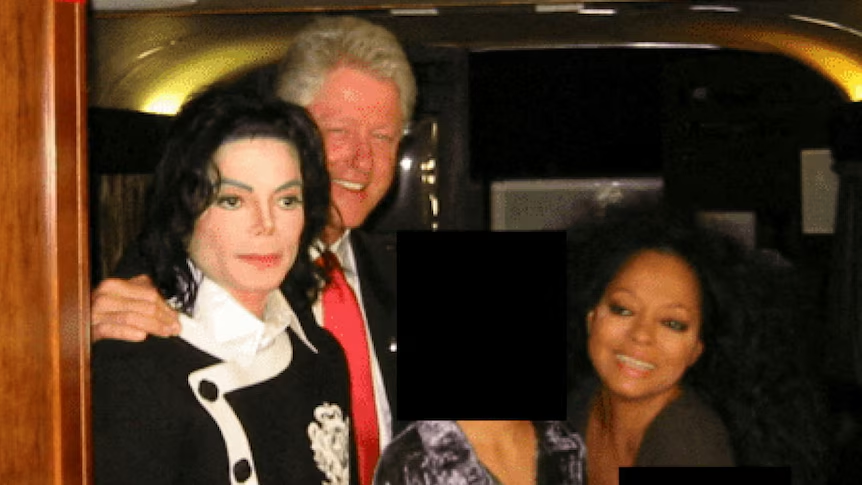
Jeffrey Epstein’s money did more than buy private jets and legal leverage. It flowed into the same ecosystem that decides which artists get pushed to the front, which research gets labeled “cutting edge,” and which stories about race and power are treated as respectable debate instead of hate speech. That doesn’t mean he sat in a control room programming playlists. It means his worldview seeped into institutions that already shape what we hear, see, and believe.
The Gatekeepers and Their Stains
The fallout around Casey Wasserman is a vivid example of how this works. Wasserman built a powerhouse talent and marketing agency that controls a major slice of sports, entertainment, and the global touring business. When the Epstein files revealed friendly, flirtatious exchanges between Wasserman and Ghislaine Maxwell, and documented his ties to Epstein’s circle, artists and staff began to question whose money and relationships were quietly underwriting their careers.
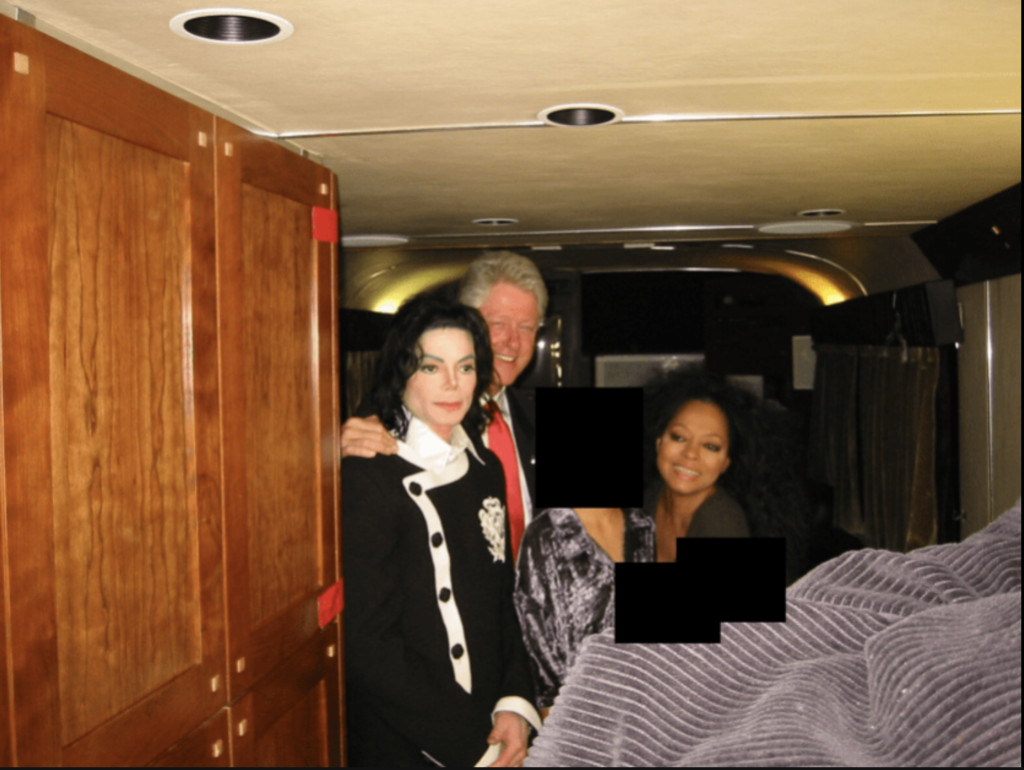
That doesn’t prove Epstein “created” any particular star. But it shows that a man deeply entangled with Epstein was sitting at a choke point: deciding which artists get representation, which tours get resources, which festivals and campaigns happen. In an industry built on access and favor, proximity to someone like Epstein is not just gossip; it signals which values are tolerated at the top.
When a gatekeeper with that history sits between artists and the public, “the industry” stops being an abstract machine and starts looking like a web of human choices — choices that, for years, were made in rooms where Epstein’s name wasn’t considered a disqualifier.
Funding Brains, Not Just Brands
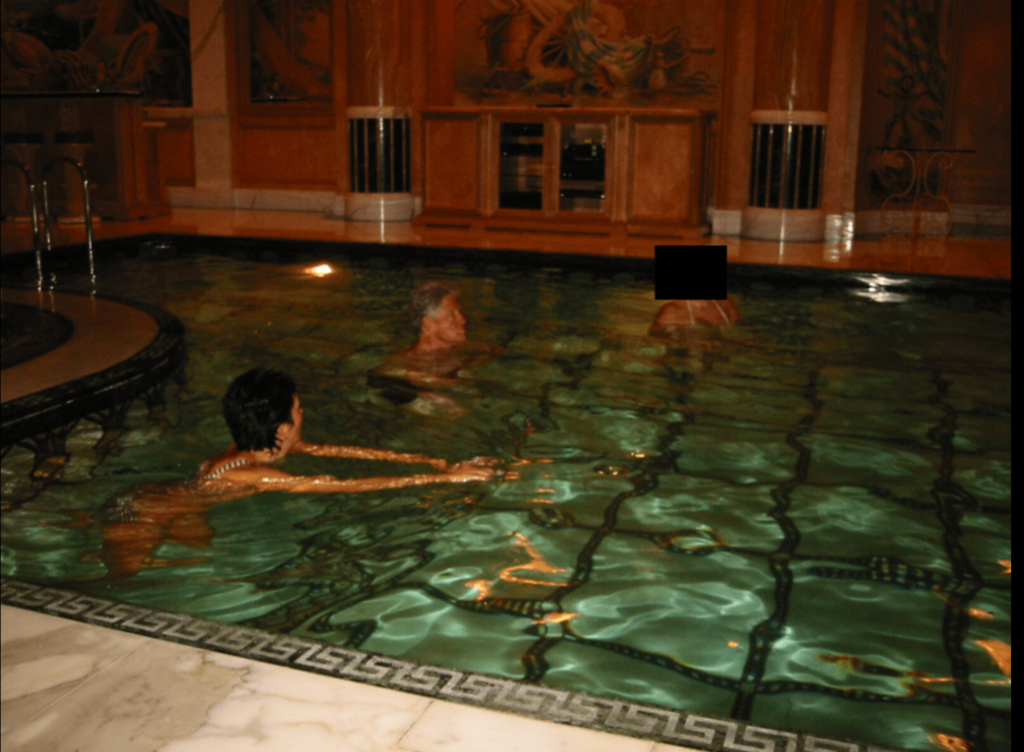
Epstein’s interest in culture didn’t end with celebrity selfies. He was obsessed with the science of brains, intelligence, and behavior — and that’s where his money begins to overlap with how audiences are modeled and, eventually, how algorithms are trained.
He cultivated relationships with scientists at elite universities and funded research into genomics, cognition, and brain development. In one high‑profile case, a UCLA professor specializing in music and the brain corresponded with Epstein for years and accepted funding for an institute focused on how music affects neural circuits. On its face, that looks like straightforward philanthropy. Put it next to his email trail and a different pattern appears.
Epstein’s correspondence shows him pushing eugenics and “race science” again and again — arguing that genetic differences explain test score gaps between Black and white people, promoting the idea of editing human beings under the euphemism of “genetic altruism,” and surrounding himself with thinkers who entertained those frames. One researcher in his orbit described Black children as biologically better suited to running and hunting than to abstract thinking.
So you have a financier who is:
- Funding brain and behavior research.
- Deeply invested in ranking human groups by intelligence.
- Embedded in networks that shape both scientific agendas and cultural production.
None of that proves a specific piece of music research turned into a specific Spotify recommendation. But it does show how his ideology was given time, money, and legitimacy in the very spaces that define what counts as serious knowledge about human minds.
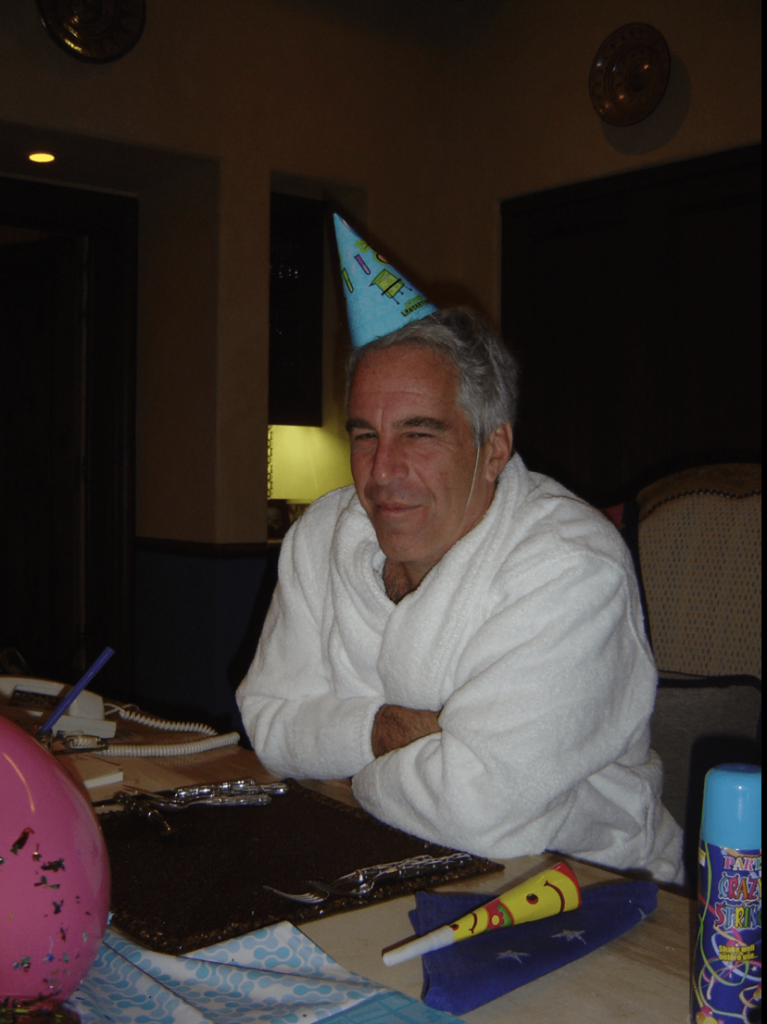
How Ideas Leak Into Algorithms
There is another layer that is easier to see: what enters the knowledge base that machines learn from.
Fringe researchers recently misused a large U.S. study of children’s genetics and brain development to publish papers claiming racial hierarchies in IQ and tying Black people’s economic outcomes to supposed genetic deficits. Those papers then showed up as sources in answers from large AI systems when users asked about race and intelligence. Even after mainstream scientists criticized the work, it had already entered both the academic record and the training data of systems that help generate and rank content.
Epstein did not write those specific papers, but he funded the kind of people and projects that keep race‑IQ discourse alive inside elite spaces. Once that thinking is in the mix, recommendation engines and search systems don’t have to be explicitly racist to reproduce it. They simply mirror what’s in their training data and what has been treated as “serious” research.
Zoomed out, the pipeline looks less like a neat conspiracy and more like an ecosystem:
- Wealthy men fund “edgy” work on genes, brains, and behavior.
- Some of that work revives old racist ideas with new data and jargon.
- Those studies get scraped, indexed, and sometimes amplified by AI systems.
- The same platforms host and boost music, video, and news — making decisions shaped by engagement patterns built on biased narratives.
The algorithm deciding what you see next is standing downstream from all of this.
The Celebrity as Smoke Screen
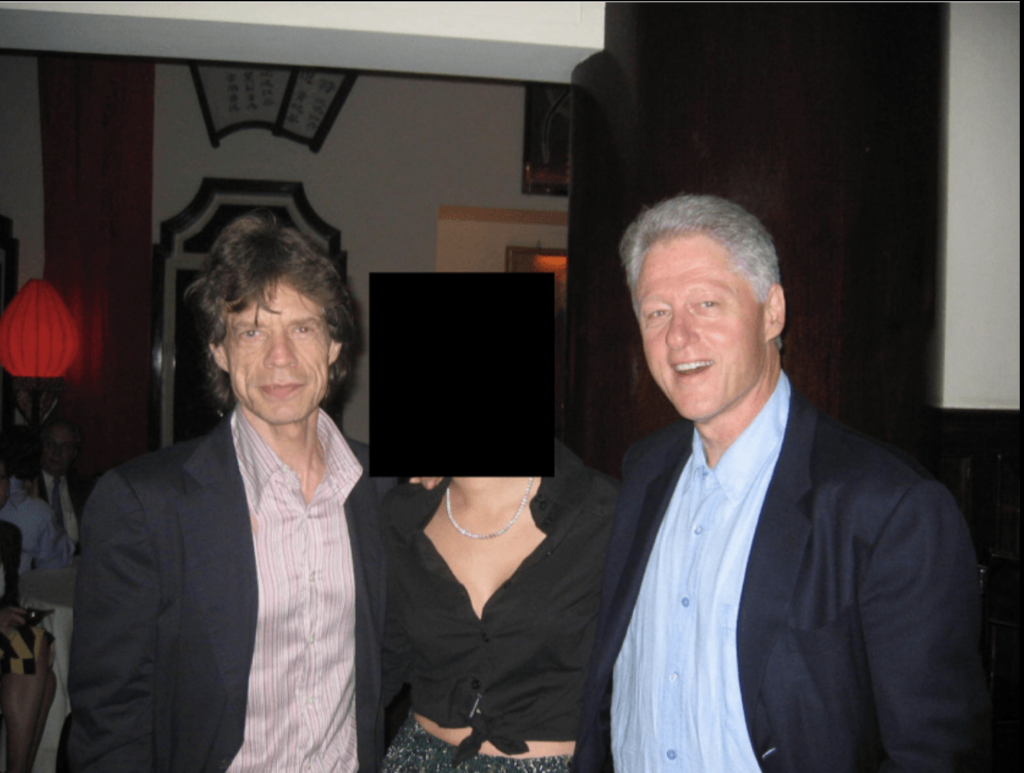
Epstein’s contact lists are full of directors, actors, musicians, authors, and public intellectuals. Many now insist they had no idea what he was doing. Some probably didn’t; others clearly chose not to ask. From Epstein’s perspective, the value of those relationships is obvious.
Being seen in orbit around beloved artists and cultural figures created a reputational firewall. If the public repeatedly saw him photographed with geniuses, Oscar winners, and hit‑makers, their brains filed him under “eccentric patron” rather than “dangerous predator.”
That softens the landing for his ideas, too. Race science sounds less toxic when it’s discussed over dinner at a university‑backed salon or exchanged in emails with a famous thinker.
The more oxygen is spent on the celebrity angle — who flew on which plane, who sat at which dinner — the less attention is left for what may matter more in the long run: the way his money and ideology were welcomed by institutions that shape culture and knowledge.

What to Love, Who to Fear
The point is not to claim that Jeffrey Epstein was secretly programming your TikTok feed or hand‑picking your favorite rapper. The deeper question is what happens when a man with his worldview is allowed to invest in the people and institutions that decide:
- Which artists are “marketable.”
- Which scientific questions are “important.”
- Which studies are “serious” enough to train our machines on.
- Which faces and stories are framed as aspirational — and which as dangerous.
If your media diet feels saturated with certain kinds of Black representation — hyper‑visible in music and sports, under‑represented in positions of uncontested authority — while “objective” science quietly debates Black intelligence, that’s not random drift. It’s the outcome of centuries of narrative work that men like Epstein bought into and helped sustain.
No one can draw a straight, provable line from his bank account to a specific song or recommendation. But the lines he did draw — to elite agencies, to brain and music research, to race‑obsessed science networks — are enough to show this: his money was not only paying for crimes in private. It was also buying him a seat at the tables where culture and knowledge are made, where the stories about who to love and who to fear get quietly agreed upon.
A Challenge to Filmmakers and Creatives
For anyone making culture inside this system, that’s the uncomfortable part: this isn’t just a story about “them.” It’s also a story about you.
Filmmakers, showrunners, musicians, actors, and writers all sit at points where money, narrative, and visibility intersect. You rarely control where the capital ultimately comes from, but you do control what you validate, what you reproduce, and what you challenge.
Questions worth carrying into every room:
- Whose gaze are you serving when you pitch, cast, and cut?
- Which Black characters are being centered — and are they full humans or familiar stereotypes made safe for gatekeepers?
- When someone says a project is “too political,” “too niche,” or “bad for the algorithm,” whose comfort is really being protected?
- Are you treating “the industry” as a neutral force, or as a set of human choices you can push against?
If wealth like Epstein’s can quietly seep into agencies, labs, and institutions that decide what gets made and amplified, then the stories you choose to tell — and refuse to tell — become one of the few levers of resistance inside that machine. You may not control every funding source, but you can decide whether your work reinforces a world where Black people are data points and aesthetics, or one where they are subjects, authors, and owners.
The industry will always have its “gatekeepers.” The open question is whether creatives accept that role as fixed, or start behaving like counter‑programmers: naming the patterns, refusing easy archetypes, and building alternative pathways, platforms, and partnerships wherever possible. In a landscape where money has long been used to decide what to love and who to fear, your choices about whose stories get light are not just artistic decisions. They are acts of power.
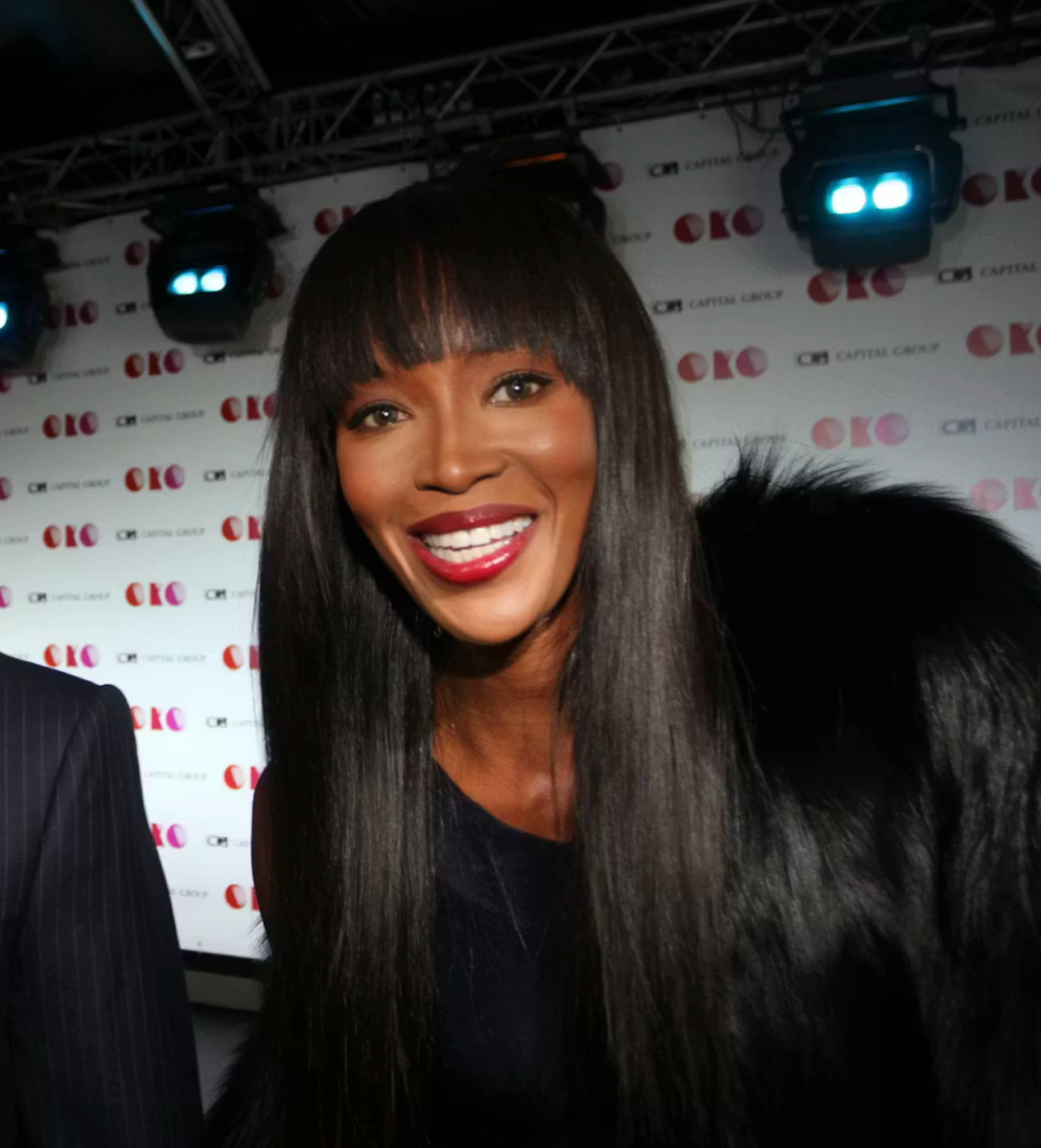
In early 2026, the global conversation surrounding the “Epstein files” has reached a fever pitch as the Department of Justice continues to un-redact millions of pages of internal records. Among the most explosive revelations are detailed email exchanges between Ghislaine Maxwell and Jeffrey Epstein that directly name supermodel Naomi Campbell. While Campbell has long maintained she was a peripheral figure in Epstein’s world, the latest documents—including an explicit message where Maxwell allegedly offered “two playmates” for the model—have forced a national re-evaluation of her proximity to the criminal enterprise.
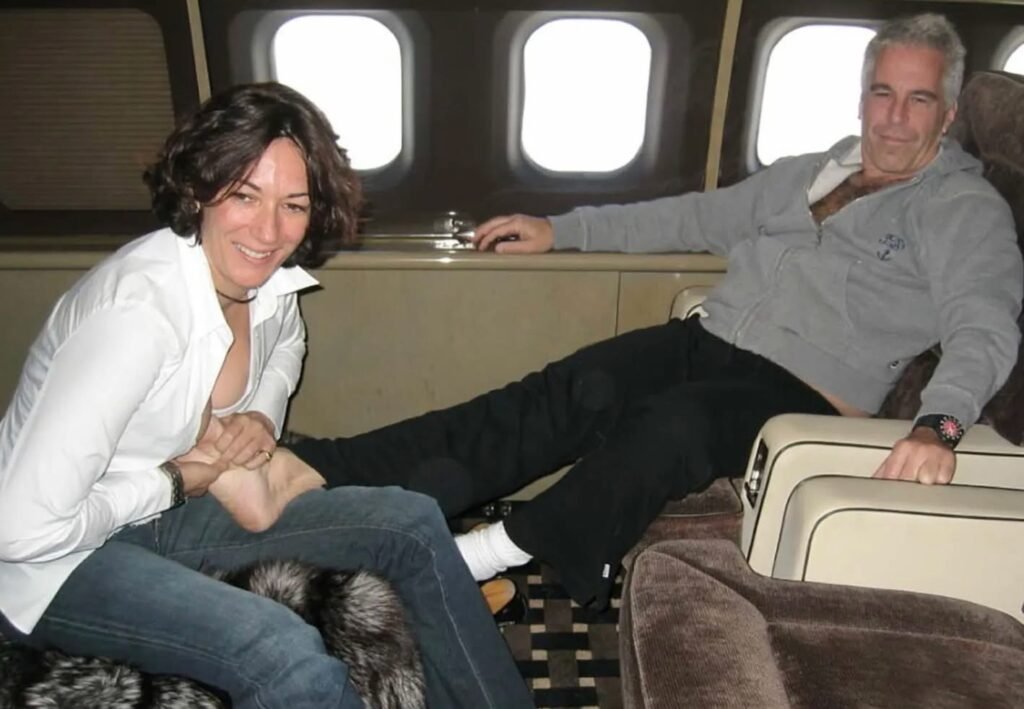
The Logistics of a High-Fashion Connection
The declassified files provide a rare look into the operational relationship between the supermodel and the financier. Flight logs and internal staff emails from as late as 2016 show that Campbell’s travel was frequently subsidized by Epstein’s private fleet. In one exchange, Epstein’s assistants discussed the urgency of her travel requests, noting she had “no backup plan” and was reliant on his jet to reach international events.
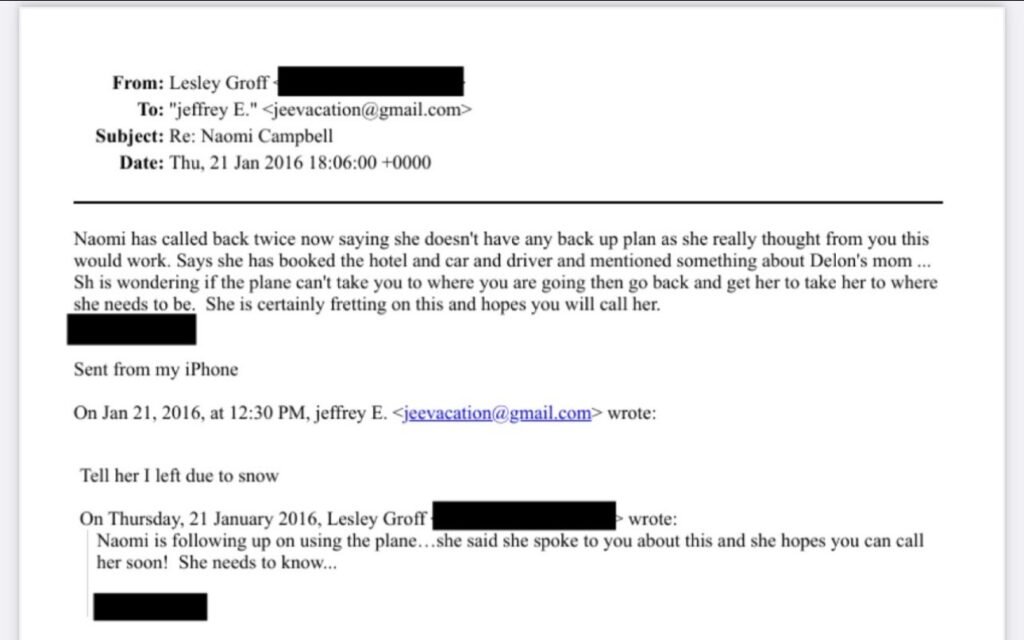
This level of logistical coordination suggests a relationship built on significant mutual favors, contrasting with Campbell’s previous descriptions of him as just another face in the crowd.
In Her Own Words: The “Sickened” Response
Campbell has not remained silent as these files have surfaced, though her defense has been consistent for years. In a widely cited 2019 video response that has been recirculated amid the 2026 leaks, she stated, “What he’s done is indefensible. I’m as sickened as everyone else is by it.” When confronted with photos of herself at parties alongside Epstein and Maxwell, she has argued against the concept of “guilt by association,” telling the press:
She has further emphasized her stance by aligning herself with those Epstein harmed, stating,
“I stand with the victims. I’m not a person who wants to see anyone abused, and I never have been.””
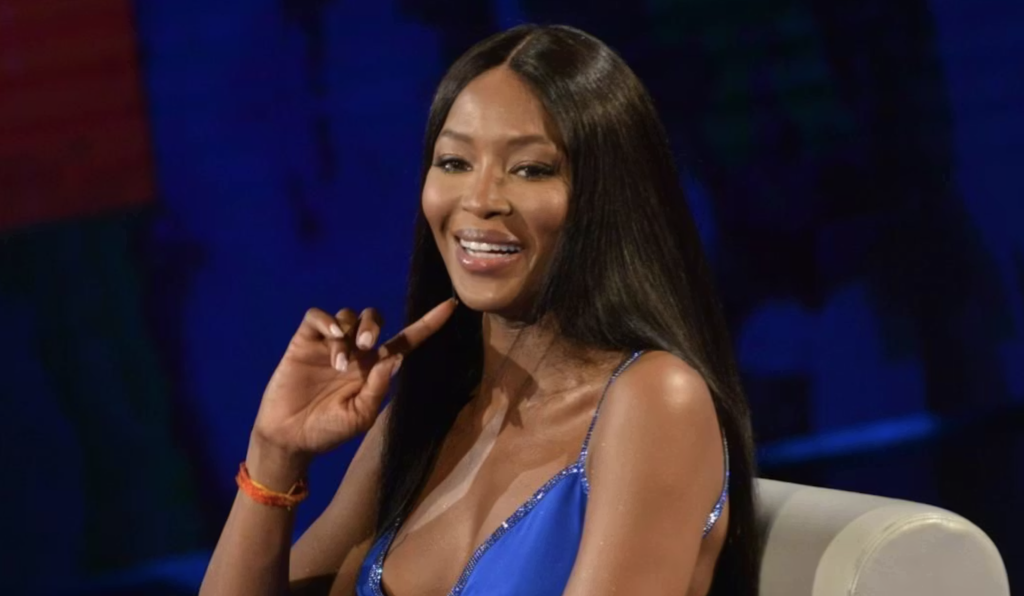
The Mystery of the “Two Playmates”
The most damaging piece of evidence in the recent 2026 release is an email where Maxwell reportedly tells Epstein she has “two playmates” ready for Campbell.
While the context of this “offer” remains a subject of intense debate—with some investigators suggesting it refers to the procurement of young women for social or sexual purposes—Campbell’s legal team has historically dismissed such claims as speculative. However, for a public already wary of elite power brokers, the specific wording used in these private DOJ records has created a “stop-the-scroll” moment that is proving difficult for the fashion icon to move past.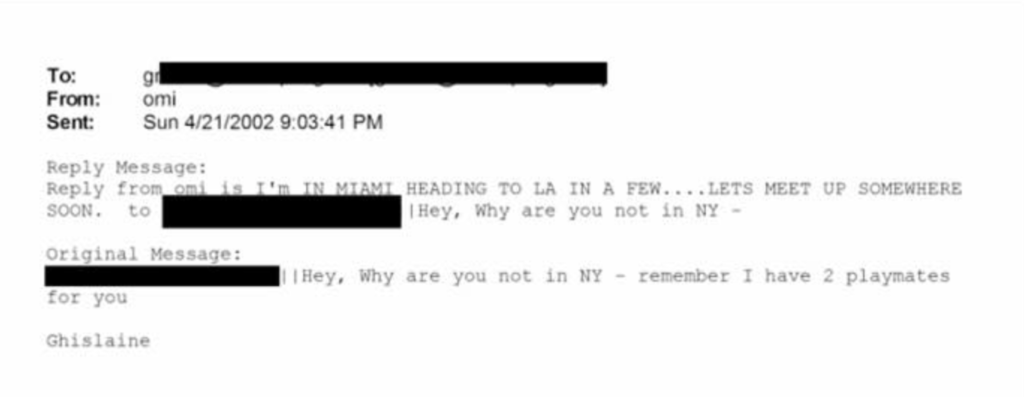
A Reputation at a Crossroads
As a trailblazer in the fashion industry, Campbell is now navigating a period where her professional achievements are being weighed against her presence in some of history’s most notorious social circles. The 2026 files don’t just name her; they place her within a broader system where modeling agents and scouts allegedly groomed young women under the guise of high-fashion opportunities. Whether these records prove a deeper complicity or simply illustrate the unavoidable overlap of the 1% remains the central question of the ongoing DOJ investigation.
Business
Google Accused Of Favoring White, Asian Staff As It Reaches $28 Million Deal That Excludes Black Workers

Google has tentatively agreed to a $28 million settlement in a California class‑action lawsuit alleging that white and Asian employees were routinely paid more and placed on faster career tracks than colleagues from other racial and ethnic backgrounds.
- A Santa Clara County Superior Court judge has granted preliminary approval, calling the deal “fair” and noting that it could cover more than 6,600 current and former Google workers employed in the state between 2018 and 2024.
How The Discrimination Claims Emerged
The lawsuit was brought by former Google employee Ana Cantu, who identifies as Mexican and racially Indigenous and worked in people operations and cloud departments for about seven years. Cantu alleges that despite strong performance, she remained stuck at the same level while white and Asian colleagues doing similar work received higher pay, higher “levels,” and more frequent promotions.
Cantu’s complaint claims that Latino, Indigenous, Native American, Native Hawaiian, Pacific Islander, and Alaska Native employees were systematically underpaid compared with white and Asian coworkers performing substantially similar roles. The suit also says employees who raised concerns about pay and leveling saw raises and promotions withheld, reinforcing what plaintiffs describe as a two‑tiered system inside the company.
Why Black Employees Were Left Out
Cantu’s legal team ultimately agreed to narrow the class to employees whose race and ethnicity were “most closely aligned” with hers, a condition that cleared the path to the current settlement.

The judge noted that Black employees were explicitly excluded from the settlement class after negotiations, meaning they will not share in the $28 million payout even though they were named in earlier versions of the case. Separate litigation on behalf of Black Google employees alleging racial bias in pay and promotions remains pending, leaving their claims to be resolved in a different forum.
What The Settlement Provides
Of the $28 million total, about $20.4 million is expected to be distributed to eligible class members after legal fees and penalties are deducted. Eligible workers include those in California who self‑identified as Hispanic, Latinx, Indigenous, Native American, American Indian, Native Hawaiian, Pacific Islander, and/or Alaska Native during the covered period.

Beyond cash payments, Google has also agreed to take steps aimed at addressing the alleged disparities, including reviewing pay and leveling practices for racial and ethnic gaps. The settlement still needs final court approval at a hearing scheduled for later this year, and affected employees will have a chance to opt out or object before any money is distributed.
H2: Google’s Response And The Broader Stakes
A Google spokesperson has said the company disputes the allegations but chose to settle in order to move forward, while reiterating its public commitment to fair pay, hiring, and advancement for all employees. The company has emphasized ongoing internal audits and equity initiatives, though plaintiffs argue those efforts did not prevent or correct the disparities outlined in the lawsuit.
For many observers, the exclusion of Black workers from the settlement highlights the legal and strategic complexities of class‑action discrimination cases, especially in large, diverse workplaces. The outcome of the remaining lawsuit brought on behalf of Black employees, alongside this $28 million deal, will help define how one of the world’s most powerful tech companies is held accountable for alleged racial inequities in pay and promotion.

The machine isn’t coming. It’s aleady the room.

The Timothée Chalamet Guide to Ruining Your Image

Did OnlyFans Save Creators—or Trap Them?


 Advice3 weeks ago
How to Find Your Voice as a Filmmaker
- News3 weeks ago
How Misinformation Overload Breaks Creative Focus
- News4 weeks ago
From Seen to Secured: How Filmmakers Are Owning Their Value
- Entertainment2 weeks ago
7 Filmmaking Lessons From Michael B. Jordan’s Oscar Moment
- Entertainment2 weeks ago
This scene almost broke him. And changed his career.
- Advice2 weeks ago
Stop Waiting for Permission — The Film Industry Just Rewrote the Rules
- News2 weeks ago
How ‘Sinners’ Won The Oscars: Filmmaker Notes
- Entertainment4 days ago
The machine isn’t coming. It’s aleady the room.